

A Strategic Approach to Mapping the Student, Parent, and Staff Experience
If your school or district is beginning or considering a brand refresh, you may be asking a deceptively simple question: Where do we start?
Is it a new logo? Updated signage? A facility upgrade? A website refresh?
In today’s climate of heightened student recruitment competition, faculty shortages, and the looming enrollment cliff, environmental branding decisions can't be cosmetic. They must be strategic and tied to outcomes.
The most effective starting point is not a design concept. It's journey mapping.
Journey mapping is the process of analyzing how students, parents, faculty, and staff physically experience your campus from the first impression to daily classroom life. When schools understand this journey, every environmental branding decision becomes more focused, more intentional, and far more likely to deliver ROI.
/School_Value_graphics-3.jpg?width=700&height=467&name=School_Value_graphics-3.jpg)
Physical Zones That Shape Institutional Identity
A typical campus contains layered zones of influence:
- Entry points and arrival sequences
- Reception and administrative areas
- Classrooms and specialized learning environments
- Hallways and transition zones
- Commons, libraries, cafés, and gathering areas
- Faculty workrooms and “back-of-house” spaces
- Room signage and wayfinding systems
- Outdoor spaces and campus landmarks
Each zone presents an opportunity to reinforce your institution identity, enhance the student experience, and support student recruitment and faculty engagement.
The question is: are they currently doing so?
Where Schools Fall Short
Most school leaders care deeply about culture, mission, and community. Yet when you walk through many campuses, the physical environment tells a fragmented story.
Across many campuses, inconsistency quietly erodes credibility. Logos vary by department, colors shift from hallway to hallway, and typography changes from sign to sign. Some graphics feel outdated or hastily produced, muddling overall visual identity. Messaging often mirrors this disconnect. Broad phrases about “excellence” may appear on walls, yet the school’s true differentiators are unclear. Achievement claims may lack visible proof. Photography can feel staged or outdated, failing to reflect the current student body. Even wayfinding and entry signage, while functional, often miss the opportunity to express purpose and personality. The result is a campus that feels disjointed rather than intentionally designed.
/School_Value_graphics-7.jpg?width=300&name=School_Value_graphics-7.jpg)
The Mapped Approach
Journey mapping goes beyond getting from point A to point B. It examines the lived experience of your campus:
- What does a parent feel upon arrival?
- What signals competence, safety, and belonging?
- Where do students see themselves reflected?
- Where do faculty feel valued and supported?
When mapped intentionally, environmental branding becomes a structured, phased process, rather than a series of isolated upgrades.
- Phase 1
- Phase 2
- Phase 3
First Impressions and Identity
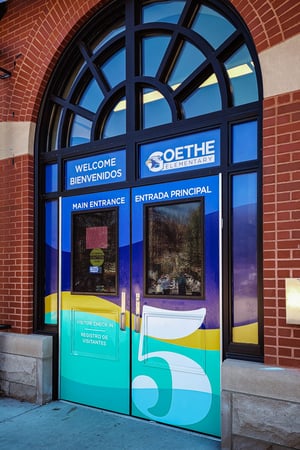
You only have one opportunity to make a first impression. Entry and reception areas should do more than identify the building; they should clearly express mission, values, and institutional identity. Exterior signage, reception walls, visible achievements, and intuitive wayfinding work together to reduce anxiety and establish credibility within moments of arrival.
This is where academic branding begins. Not with decoration, but with clarity of identity.
Entry Points
- Exterior signage that communicates credibility and clarity
- Reception walls that combine logo, mission, and institutional values
- Donor or achievement displays reinforcing academic excellence
- Clear wayfinding reducing anxiety for first-time visitors
The Learning Environment
Classrooms are the microcosm of your campus experience. Branding here should not overwhelm; it should quietly reinforce purpose. Walls should be a whispering testament to the mission of the space, supporting focus, celebrating growth, and aligning with pedagogy. When form follows function, the environment strengthens the learning experience rather than distracting from it.
- Subtle reinforcement of core values
- Visual cues supporting learning goals
- Age-appropriate messaging aligned to mission
- Thoughtful color use supporting focus and calm
Campus Finalization
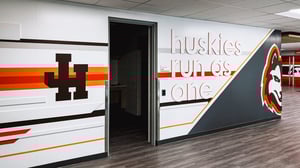
Between the classroom and the broader campus lie hallways, commons, and connection zones. These transition areas are powerful cultural touchpoints. Storytelling walls, recognition displays, cohesive color systems, and branded ADA-compliant wayfinding transform blank corridors into a passive, silent partner in your marketing efforts.
Even faculty workrooms and “back-of-house” areas deserve attention. The spaces where educators recharge communicate just as much about institutional values as the spaces where students learn.
Break Room Areas (“Back of House”)
- Messaging can be more relaxed
- Faculty-focused encouragement
- Celebrations of staff achievements
- Subtle reinforcement of institutional values
Faculty engagement begins in the spaces where educators recharge.
Room Signage and Wayfinding
- ADA-compliant signage systems
- Subtle brand cues integrated into necessary elements
- Cohesive typography and color usage
Just because it is functional does not mean it has to be generic.
Start With a Campus Experience Audit
Before implementing change, map the current journey. Walk your campus as if you are a prospective parent. As a new teacher. As a student on their first day. Where does the experience feel intentional? Where does it feel fragmented?
Document what exists. Identify friction points. Note inconsistencies. Observe how students, families, and staff actually move through the space.
This diagnostic step ensures future facility upgrades are aligned to experience and not just aesthetics.
Mapping Your Identity Into Space
No two schools share the same mission, demographics, or aspirations. Still, many campuses feel interchangeable. Journey mapping prevents that. It forces leaders to ask how their unique culture should show up physically at every touchpoint.
If collaboration defines your pedagogy, does the environment visibly support it? If heritage and tradition matter, are those stories embedded in the campus narrative?
School design must translate culture into form, as the physical campus is not just where education happens. It is how education is experienced.
And experience, when mapped intentionally, becomes your most powerful strategic advantage.
-
All
-
Entry Points
-
Faculty Spaces
-
Commons
-
Transition Zones
/D214_WallGraphics-12.jpg?width=300&name=D214_WallGraphics-12.jpg)
/School_Value_graphics-11.jpg?width=300&name=School_Value_graphics-11.jpg)
/D214_PHS3_WebSize-8.jpg?width=300&name=D214_PHS3_WebSize-8.jpg)
/D214_WallGraphics-1.jpg?width=300&name=D214_WallGraphics-1.jpg)
/School_Value_graphics-14.jpg?width=300&name=School_Value_graphics-14.jpg)
/Maerker%20School_edit1.jpg?width=300&name=Maerker%20School_edit1.jpg)

Connecting People and Brand at Scale.
As brand storytellers, we combine creative design, precision printing, and expert installation to transform walls, windows, and spaces into meaningful experiences.


