
<img src="https://www.365operation.com/807273.png" style="display:none;">
Skip to content
D214_CaseStudy_Phs1_web-43
Caroline SkoogMay 4, 2026 12:17:29 PM5 min read

Safe Schools Start With Environmental Design: The CPTED Approach

Safe Schools Start With the Environment: What CPTED Tells Us About School Design

When school leaders think about campus safety, the conversation usually jumps straight to technology — cameras, metal detectors, access control systems. But a growing body of research suggests we may be overlooking one of the most powerful safety tools available: the built environment itself.

Crime Prevention Through Environmental Design, known as CPTED (pronounced "sep-ted"), is a multidisciplinary approach to crime prevention that uses "urban and architectural design and the management of built and natural environments" to reduce risk and build community.² Its strategies aim to deter criminal behavior before it occurs and build a sense of belonging and ownership among the people who use a space every day.

For school administrators and district leaders, CPTED offers something rare: a framework where safety goals and school culture goals are the same goal.

The Five Principles & Why They Sound Familiar

The CDC's CPTED School Assessment defines five principles for evaluating school environments.¹ If you've thought seriously about your campus, you've probably been working within these principles already, just without the name attached.

Natural Surveillance is about designing spaces to maximize visibility and eliminate areas where threats can go undetected. Good lighting, open sightlines, and clearly defined common areas all serve this function.

Access Management uses layout, signage, and design to guide people along appropriate paths and restrict unauthorized entry. Effective wayfinding graphics are one of the most practical tools in this category.

Territoriality uses physical attributes to express ownership and pride, communicating that a space is claimed, cared for, and that behavior within it matters.¹ This is where environmental branding and school spirit graphics do real work.

Physical Maintenance reinforces the message that someone is watching and someone cares. A well-maintained environment signals social control; a neglected one invites disorder — a concept supported by decades of research in criminology.³

Order Maintenance addresses minor behavioral issues before they escalate, promoting a culture of decorum through environmental cues rather than enforcement alone.¹

What the Research Shows

A peer-reviewed study published in the Journal of School Health found that schools with higher CPTED assessment scores showed lower levels of violence and significantly lower odds of students missing school due to safety concerns, with adjusted odds ratios ranging from 0.32 to 0.63.⁴

The same study raised a pointed question about where school safety dollars are going: "Millions of dollars are being spent adding high-tech security equipment (e.g., video surveillance, weapon detection) to schools despite limitations such as cost effectiveness and inconsistent evidence of effectiveness." It further noted that some high-security measures, like metal detectors, are actually "associated with a greater likelihood a student will be worried about crime." The researchers concluded that CPTED "may be a more effective, cost-efficient, and socially positive way to enhance safety in schools."⁴

The research also clarified what students and staff associate with feeling safe: not surveillance infrastructure, but "good lighting, actively used buildings, well-maintained areas, secured entrances and exits... and signs of caring (art, murals, gardens)."⁴ That last item is not incidental. It's a design principle.

Territorial Reinforcement:

Where School Branding Becomes a Safety Strategy

Perhaps the most exciting intersection between CPTED principles and what we do at Cushing is the concept of Territorial Reinforcement. According to CPTED theory, clear spatial definition and visible boundaries, created through "landscaping, fencing, signage, or other design elements — foster a distinct sense of ownership, responsibility, and accountability among users and managers."³


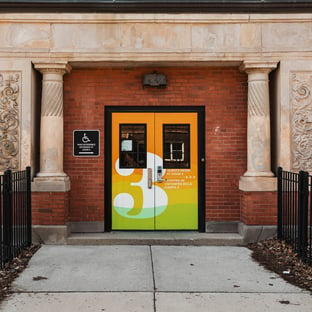
D214_CaseStudy_Phs1_web-42

In plain terms: when students see their school's identity reflected on the walls around them, they are more likely to take ownership of that space. When visitors see a well-maintained, visually confident environment, they receive a clear signal that this is a place where conduct is expected and disorder will not be tolerated.

This is corroborated by the CDC's own CPTED assessment guidance, which notes that strategies promoting territoriality "can enhance a school's aesthetic quality and bolster pride for students, staff, and the community, which in turn may promote prosocial behaviors."⁴

School spirit graphics, environmental branding, and wall graphics for schools aren't decorative add-ons. They're active expressions of territorial reinforcement. They say, without a word, this place belongs to us, and we take care of it.Hersey High School EGD
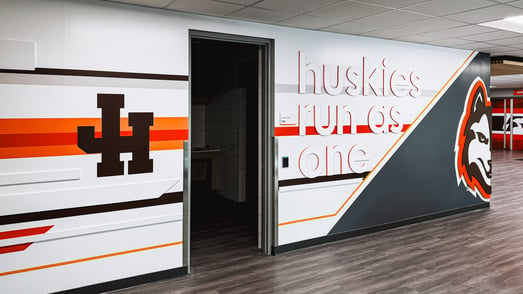
Goethe Wayfinding Web opt-3Beyond branding, wayfinding systems serve a specific safety function. Efficient routing, or "logical pathways supported by intuitive wayfinding and orientation points,"  reduces confusion, supports natural surveillance, and critically, "supports escape options in case of emergency."³ Educators focused on school design and safety planning should view wayfinding not as a visitor amenity but as functional infrastructure.

Implementing CPTED well starts with stakeholder engagement. As Alan Walters of Georgetown County School District notes, schools serve as cultural, sporting, and community centers. Involving those stakeholder groups in the design process actively bolsters territorial reinforcement.⁵ That principle shapes how we approach every school campus project.

An Investment With Lasting Returns

Budget constraints are a permanent reality for most districts. That's precisely why CPTED-informed environmental design deserves serious attention. Unlike recurring personnel costs or capital-intensive surveillance infrastructure, a well-executed campus branding and wayfinding system is a one-time investment that keeps working. It communicates safety. It builds culture. It supports enrollment by giving prospective families and students a tangible sense of what your school stands for. And according to the research, it may actually do more to reduce fear of crime and violence than the high-tech alternatives many districts are spending on.

If you're evaluating what to do with your building over the summer, or working with an architecture firm on a new or renovated campus, the question worth asking isn't just what do we need to add for security. It's what does this environment communicate and to whom.

That's a question we've been helping schools answer for years.


Connecting People and Brand at Scale.

Curious what a CPTED-informed environment could look like at your school?

We'd love to walk through your campus with you.

Citations

  1. Centers for Disease Control and Prevention. CPTED School Assessment (CSA). National Center for Injury Prevention and Control, Division of Violence Prevention; Carter & Carter Associates, 2017.

  2. International CPTED Association. What Is CPTED? cpted.net.
  3. López, M. & van Soomeren, P. Crime Prevention Through Environmental Design (CPTED) Theory and Praxis. White Paper, CPTED Research Group, Inholland University of Applied Sciences, March 2026. CC-BY 4.0.
  4. Vagi KJ, Stevens MR, Simon TR, et al. "CPTED Characteristics Associated With Violence and Safety in Middle Schools." Journal of School Health. 2018;88(4):296–305.
  5. Walters, A. "Incorporating Crime Prevention Through Environmental Design." EdMarket.org. Georgetown County School District.
avatar
Caroline Skoog
Caroline Skoog is Cushing's marketing coordinator.
COMMENTS