


<img src="https://www.365operation.com/807273.png" style="display:none;">
Skip to content
200 S Wacker
Caroline SkoogJun 16, 2026 2:34:59 PM

Chicago's Office Triptych Part 1: The Trophy Bet at 919 W. Fulton

919 W. Fulton is Chicago's only new high-end office to break ground since 2023 and the last one the city will see for the foreseeable future. What that means for trophy property, the westward migration of CBD leasing, and the next four years of tenant decisions. Read Part & Part 3.

Walk west out of Ogilvie Transportation Center, cross the river, and within minutes you'll pass three completely different commercial real estate markets. The first is a new trophy tower that opened in January, the last of its kind for the foreseeable future. The second is a 1980s-era office tower mid-renovation, the subject of a $30 million bet that capital and design can reset a building's identity. The third is an 18-year-old former tech headquarters whose first residents moved in last month, as it's no longer an office.

Same skyline, same Q1 2026 vacancy report, but three different stories.

Chicago commercial real estate in 2026 isn't bifurcated. We've reached a three-pronged fork in the road. It's trifurcated. The 27.0% CBD direct vacancy figure reported by CBRE via REjournals — and the 25.5% metro-wide vacancy and 1.8 million square feet of negative net absorption that closed out 2025, per REBusiness Online — flatten those three different stories into one headline. To understand where the city's office sector is going, you have to look up from the averages and start reading the buildings. This article is Part 1 of a three-part series diving into the nuances of those building narratives.

We start at the top of the market. The Fulton, a $350 million development that opened in late January at 919 W. Fulton Street, is the only high-end office building to break ground in Chicago since 2023. No additional new office projects are currently under construction anywhere in Chicago's CBD. The Fulton is, for the foreseeable future, the last new trophy tower the city is going to see.

A lot rides on one building.

Intro Title

SECTION STATS COUNTER - TITLE

Sources: [1] CBRE via REjournals  [2] Chicago Sun-Times

[3] Crain's Chicago Business [4] Chicago Sun-Times

27% Q1 2026 Chicago CBD direct vacancy
1 new high-end office building to break ground in Chicago since 2023
85% steepest discount lenders are now taking on troubled CRE loans, as the "extend and pretend" era ends
25 ongoing Chicago office-to-residential conversions

The last new trophy in Chicago

The Fulton was approximately 60% leased as of mid-quarter, with pre-leasing hovering near 50%. Strong numbers by any 2026 standard, according to Transwestern data reported by the Chicago Sun-Times. Anchor tenants include Harrison Street Asset Management (relocating its headquarters to the building) alongside Permanent Capital and BlackEdge Capital. Equinox and Gibsons Bar & Steakhouse hold the retail.

The building's design choices tell you almost everything about what the next generation of trophy property looks like in Chicago. The Fulton bridges new construction with the adaptive reuse of the original Schwinn bicycle factory, pairing fresh, hospitality-grade Class A+ inventory with the preserved industrial character that defined Fulton Market's identity long before the corporate corridor arrived. Here, heritage is a competitive advantage in a submarket where tenants are choosing industrial grit over Loop polish.


Why trophy keeps moving west

The submarket math underscores why The Fulton matters. Fulton Market posted 221,384 square feet of positive net absorption in Q1 2026 — the only downtown submarket to record gains. The West Loop captured more than 60% of new Class A leasing activity in the same quarter, per CBRE. Jeff Skender, managing director at Cushman & Wakefield's Chicago office, summarized the bifurcation to REjournals: "Trophy towers seeing vacancies below 10% while Class B and C properties are experiencing vacancy rates of 30% or more. Flight to quality continues to be the trend through Q1 2026."
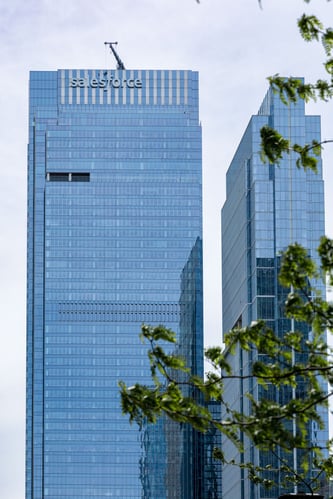
Salesforce Building

By comparison, the prior generation of trophy properties (150 N. Riverside Plaza, Bank of America Tower, Salesforce Tower, River Point) continues to perform at the Loop's high end.  Per CoStar's reporting, these buildings have "little unleased space" even as the broader market struggles, and gross rents at high-rise floors in towers like 110 N. Wacker Drive, 150 N. Riverside, and 444 W. Lake Street are running $80 to $90 per square foot, per Crain's reporting. The Loop trophy class is not dying. But the next generation of trophy capital has gone west. Further west than the Loop, further west than the Wacker Drive corridor, all the way to Fulton Market. As the Chicago Architecture Center observed in its Our Changing Downtown brief, this is the continuation of a decade-long migration toward the commuter rail hubs at Union and Ogilvie. Trophy follows transit, talent, and amenity density.


The bottleneck coming by 2030

For tenants requiring large, contiguous Class A blocks downtown, the implication is hard. "The lack of new construction downtown is creating a bottleneck of Class A space between now and 2030," CBRE Senior Vice President Jon Milonas told REjournals. Pre-leasing well ahead of any 2030 delivery is the likely outcome.

 What 919 W. Fulton signals for the Chicago office sector: 

  • Trophy remains the safest seat in the market

  • The center of gravity has decisively moved west

  • The supply window is closing.

  • Tenant decisions made between now and 2028 will determine who's locked into desirable space when the inventory tightens.

What the trophy trajectory means for environmental branding

For tenants relocating into a trophy build like The Fulton, the brand environment is the first thing every employee, client, and visitor experiences the moment the elevator opens. Hospitality-grade Class A+ inventory delivers a baseline of polish at the building level, but the tenant's identity within that envelope is what differentiates the experience from the floor below or the floor above. Environmental branding does that work: signage, wayfinding, interior brand language, and visual systems that translate a company's identity into its physical space without competing with the architecture.

Relocations into new construction are also inflection points. The space is being commissioned. The opportunity to define how a company shows up — physically, visually, experientially — is open exactly once. At Cushing, we pay close attention to trophy moves like the ones happening at The Fulton because environmental branding is most effective when it's planned alongside the built environment, not retrofitted into it later.


Two more trajectories run in parallel

919 W. Fulton tells us what's happening at the top of Chicago's office market. It doesn't tell us what's happening below it. The same Q1 vacancy report that gave the West Loop a 22.8% direct vacancy rate also recorded River North at 34.4% and the East Loop at 31.8%. The buildings in those numbers aren't sitting still; they're being repositioned, recapitalized, and in some cases permanently converted to other uses. That's the rest of the story.
Connecting People and Brand at Scale.

Curious how environmental branding could shape your next trophy build, repositioning, or conversion?

We'd love to walk the space with you.


Citations

FREE RESOURCE

Your Office Branding Project Guide

 An office branding project is a coordinated effort that brings together brand identity, workplace culture, operational needs, and physical execution. This guide is designed to help you navigate that process with clarity. It breaks an office branding project into realistic phases, highlights common decision points, and provides practical guidance to help you plan confidently.


avatar
Caroline Skoog
Caroline Skoog is Cushing's marketing coordinator.
COMMENTS