

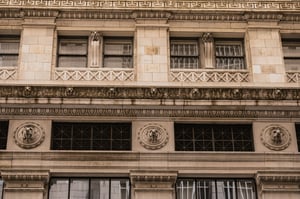
Last month, the first residents moved into a former Salesforce headquarters in River North. A few blocks south, a 1914 LaSalle Street landmark is preparing for its own transformation. Two conversions, two completely different vehicles, one trajectory permanently reshaping Chicago's downtown.
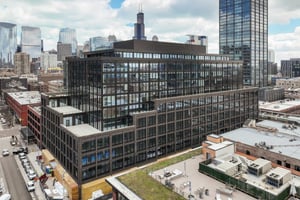
The first residents moved into a building in River North last month that, until recently, housed Salesforce headquarters. 111 W. Illinois Street represents the third trajectory reshaping Chicago's office market: the one where the office isn't an office anymore.
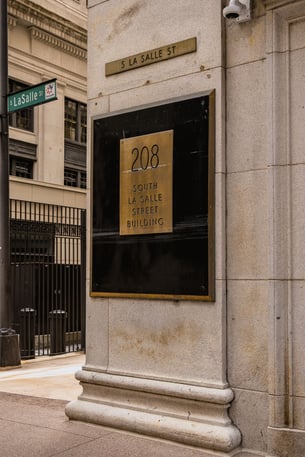 A few blocks south, on LaSalle Street, a 1.2 million-square-foot Chicago landmark completed in 1914 is preparing for its own transformation. 208 S. LaSalle will become 226 residential units in the floors between two existing hotels — a $122.7 million project backed by $26.2 million in TIF support and forming part of the City of Chicago's LaSalle Corridor Revitalization initiative.
Same destination: residential. Entirely different vehicles.
Chicago commercial real estate in 2026 isn't bifurcated. It's trifurcated. The 27.0% CBD direct vacancy figure reported by CBRE via REjournals flattens three completely different stories into one headline: new trophy construction at the top of the market (Part 1: The Trophy Bet at 919 W. Fulton), distressed buildings being rescued with reset valuations and new capital (Part 2: The Reset Bet at 200 S. Wacker), and the trajectory this piece is about: older office properties being permanently converted to residential or mixed use.
Welcome to Part 3. Conversion may be the most consequential of the three trajectories for the long-term shape of Chicago's downtown, and it's already happening at scale.
111 W. Illinois (111 Point)
The first residents of 111 Point moved in on May 22. Path Construction and WindWave Real Estate spent eight months and $64.5 million converting a former Salesforce headquarters into an apartment building in River North. The full project is expected to be complete by July 1, per the Chicago Sun-Times.
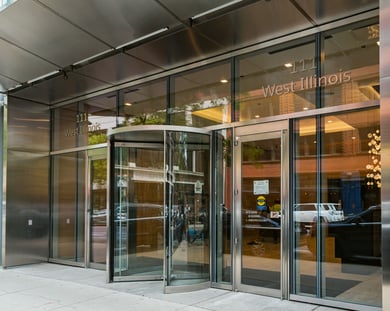
The "newer than you'd expect" detail is the one worth lingering on. 111 W. Illinois was built in 2008. It’s only 18 years old. It cycled from Salesforce HQ to WeWork to Industrious before being marked for conversion. This is not a 1930s relic that obviously belonged in residential. This is a building that should have been a competitive Class A office and couldn't be. As the Sun-Times reported, the building "lacked the high-end amenities that could draw in companies." That alone tells you how high the bar has moved for office product in Chicago.
The unsung hero of conversion economics is floor plate width. As Jon Cordell, WindWave's managing partner, explained: 111 W. Illinois's dimensions allowed every unit to have windows and natural light. Wider office buildings often can't be converted because the center of the floor sits too far from the windows. The difference between "convertible" and "stranded" frequently comes down to that one architectural variable.
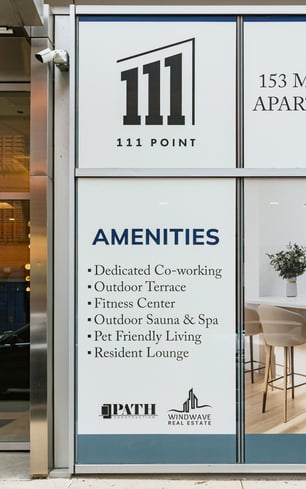
Design moves at 111 Point reflect what residential users in 2026 actually want: 10-foot ceilings, walk-in closets, even 500-square-foot studios that "feel spacious." The former Industrious coworking infrastructure (conference rooms, phone rooms) was repurposed into the building's own coworking lounge with private rooms and a podcasting studio, meeting the now-standard apartment-building demand for high-quality work-from-home space.
The submarket backdrop sharpens the image. River North carries roughly 25% office vacancy and accounted for 13% of Q1 2026 CBD leasing activity, per Bradford Allen — a neighborhood that is simultaneously troubled and active. Conversions like 111 Point are the rational response to that paradox.
208 S. LaSalle
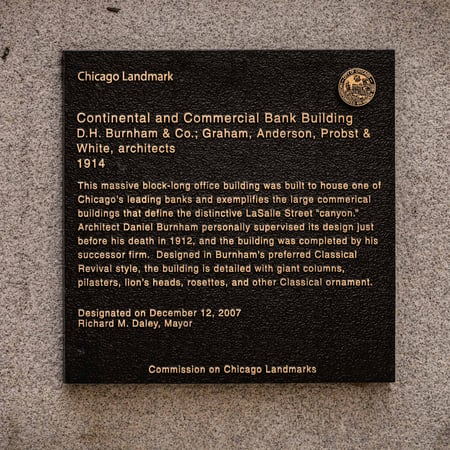
208 S. LaSalle is a 1.2 million-square-foot Chicago landmark completed in 1914 and listed on the National Register of Historic Places. The 610-key JW Marriott Chicago occupies the first 12 floors. The 232-key LaSalle Hotel occupies the top five. The conversion in between — 222,500 square feet across floors 13 through 16 — will become 226 residential units, a third of them affordable, with new lobby, fitness facilities, lounge spaces, and penthouse-level terraces including an outdoor pool. Mike Reschke's Prime Group is the developer, with Lamar Johnson Collaborative leading design, per Multi-Housing News.
Total project cost runs $122.7 million, including $26.2 million in TIF support, according to Crain's.
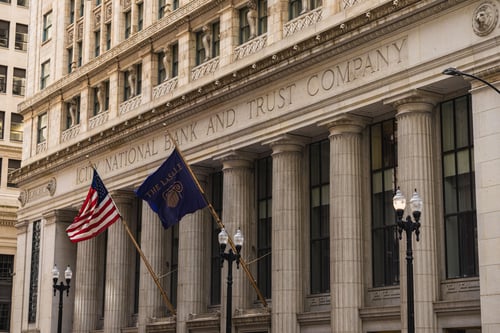
The TIF participation is a structural program. 208 S. LaSalle is one of six office-to-residential conversions advancing along the LaSalle Street Corridor as part of the City of Chicago's LaSalle Corridor Revitalization initiative. The six projects collectively represent nearly $900 million in total investment, with approximately $300 million in TIF support from the Community Development Commission. Chicago Deputy Mayor of Business, Neighborhood and Economic Development Kenya Merritt described the strategy in Multi-Housing News: "The core objective here is to create a 24/7 environment and shift away from the traditional 9-to-5 business district model."
LaSalle Street as a 9-to-5 banking corridor is being deliberately reauthored with public capital into a mixed-use neighborhood with residential, retail, cultural, and dining anchors. It's an explicit civic intervention in a submarket where private capital alone would not have moved.
The Contrast Is the Point
 Conversion isn't one story. Private capital is doing it in River North on its own terms: leaner, faster, less encumbered, willing to walk away from buildings whose floor plates won't cooperate. Public-private partnership is doing it on LaSalle: slower, a bit more complex, but tackling historically protected and structurally complicated buildings that pure private capital wouldn't touch, while building affordable units into a downtown housing stock that has been priced almost entirely out of reach. Both pathways are necessary. Neither alone would be sufficient.
Other conversion candidates corroborate the trajectory's scale. Crain's reported in May that Prime Group is under contract to acquire 55 W. Monroe Street, currently 19% leased, at an approximately 90% discount from the building's 2014 sale price, with apartments or hotel as the likely future use. The conversion wave in Chicago commercial real estate is broad, not isolated.
What these conversions signal:
-
Adaptive reuse is permanently removing the most distressed office inventory from the Chicago market
-
The buildings being saved aren't all old — some, like 111 W. Illinois, are barely 18 years old and still couldn't compete as office
-
Private capital and public-partnership pathways are both necessary; neither alone reaches the full inventory of conversion candidates
-
The Class A office bar has moved high enough to render some relatively recent construction obsolete for its original purpose
Two other trajectories run in parallel
Conversion is one of three trajectories playing out across Chicago's office sector at the same time.
looks at the last new high-end office building to break ground in Chicago since 2023 — and what it signals about the closing supply window for Class A space.
Read Part 2
Your Office Branding Project Guide
An office branding project is a coordinated effort that brings together brand identity, workplace culture, operational needs, and physical execution. This guide is designed to help you navigate that process with clarity. It breaks an office branding project into realistic phases, highlights common decision points, and provides practical guidance to help you plan confidently.